It shows up at renewal, but it usually starts when a customer never reaches first value. Arlen is the one owner from closed-won: it rides alongside your reps through onboarding, then stays on through adoption and renewal. An AI agent owns your long tail; your people direct Arlen on strategic accounts. You pay for outcomes, not seats.
Prototype screens, fictional demo data.
The evidence
Forrester: a quicker time to value “may be the most critical driver of revenue retention and account growth.” Retention Starts At Onboarding, 2025 (public summary).
McKinsey: B2B SaaS companies with the most sophisticated value-realization and adoption journeys see NRR about 7 points higher. Leaders set onboarding goals and incentivize time to value. NRR advantage, Nov 2025.
Bain: software buyers rank help with technical implementation as their top customer-success priority; vendors rank it sixth. Why CS is failing, Sep 2024.
Also: Bain’s The Rebirth of Customer Success (Nov 2026) and Gainsight’s refounding letter argue for one owner and outcomes, not activity. Every figure here was checked on the publisher’s page.
It shows up at renewal
Goals, key dates and stakeholders live in CRM fields and call notes. Each team starts over, and the customer repeats themselves.
Your smaller accounts never get a CSM. They drift quietly until the renewal date, and then it's too late.
CS tools show dashboards to people who are already stretched. Value the customer hasn't realised is revenue you haven't earned.
How it works
Arlen runs the same loop a great account owner does, for every account, every day. Routine work happens on its own. Anything risky waits for a person to approve.
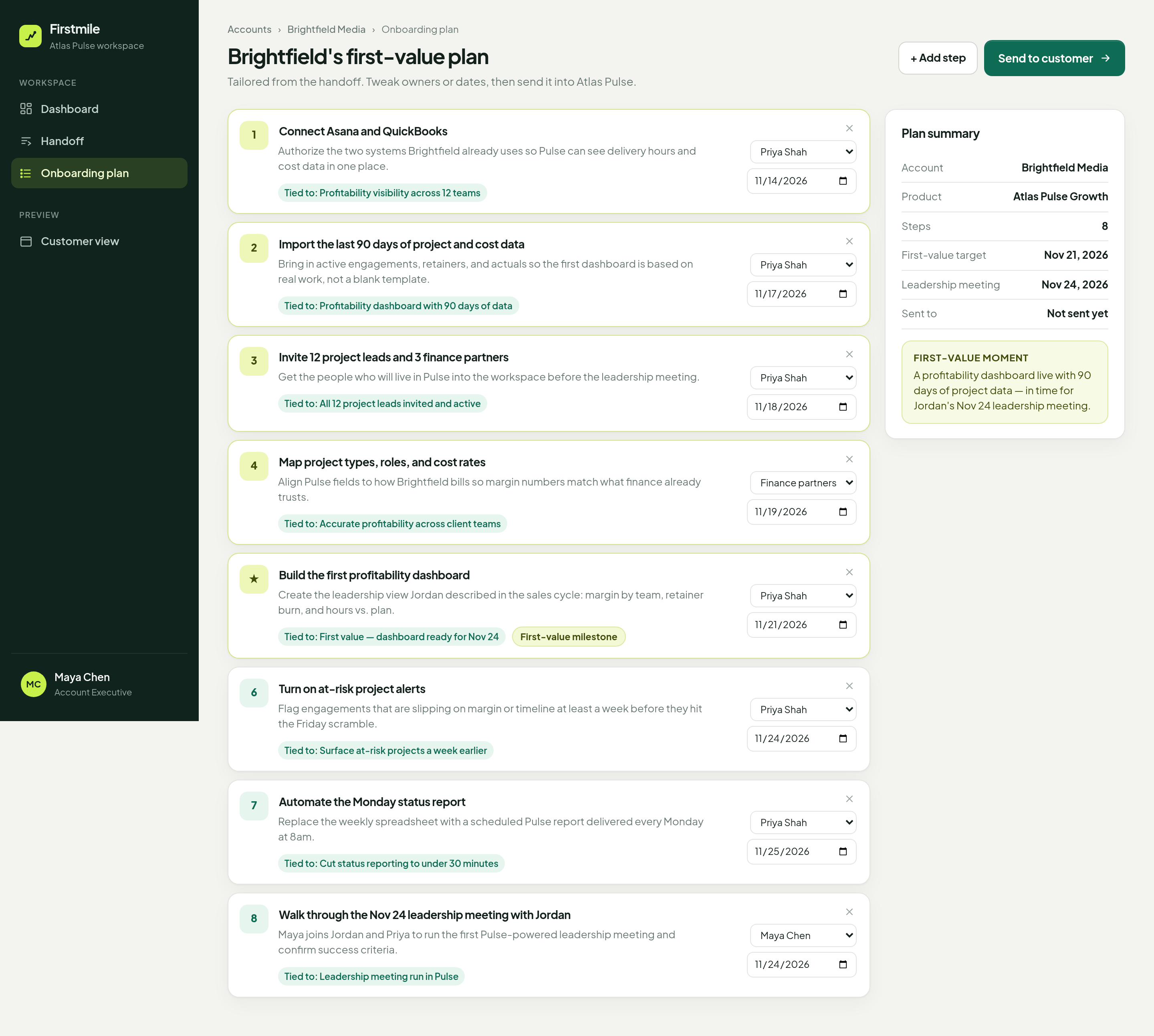
When a deal moves to Closed Won in HubSpot, Arlen picks up the goals, tools, champion and key dates, and sets the first target: first value before the date that matters.
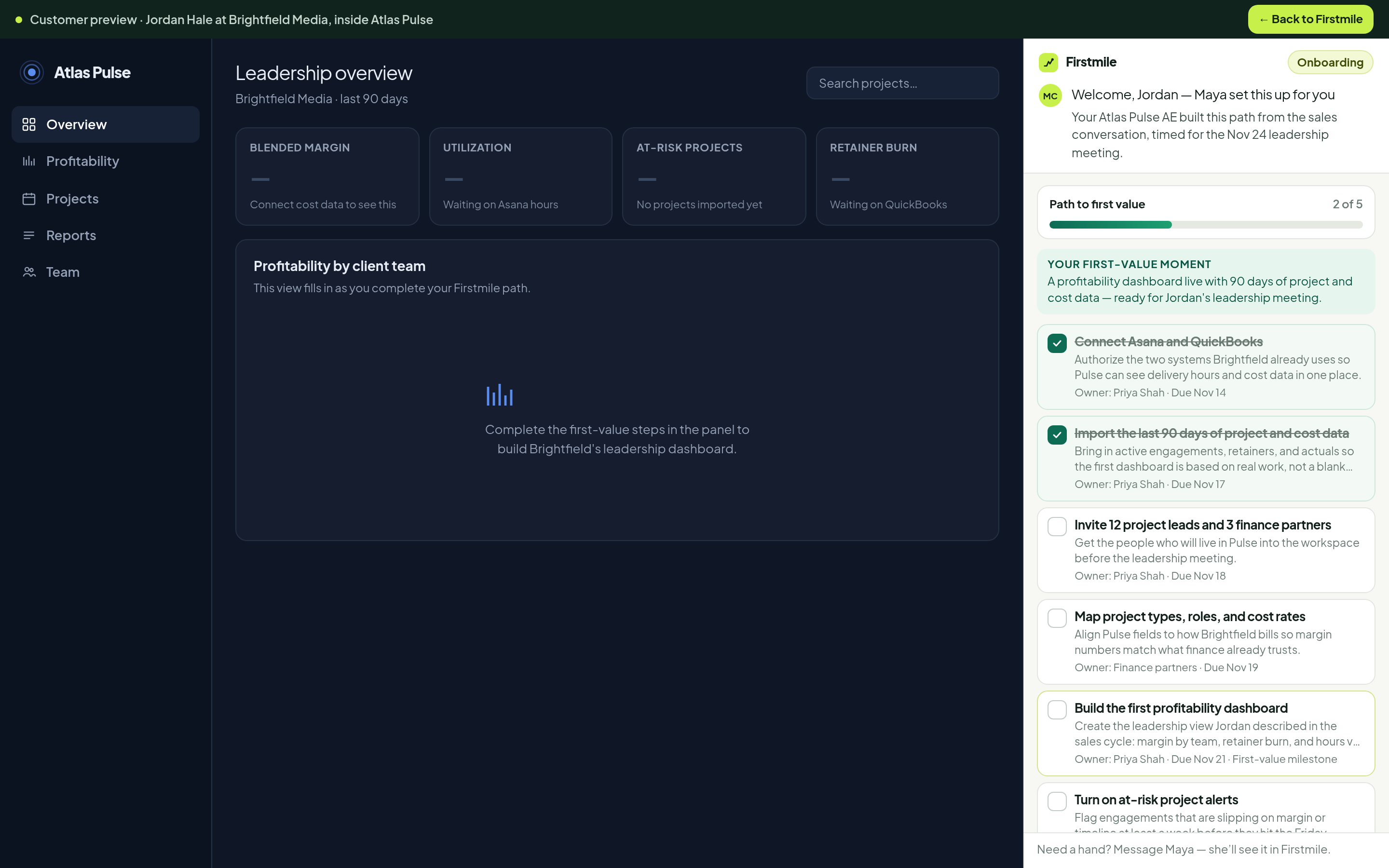
A tailored plan appears in a panel inside your product. Arlen nudges the right people, replans when dates slip and keeps your CRM up to date.
Product events, replies and CRM changes show what's working. Steps complete on their own, and health is scored with plain-language reasons.
After first value comes adoption, then renewal and expansion. Arlen sets the next goal, flags risk early, and drafts the renewal recap or expansion play.
We're starting where value starts: sales-led onboarding and time to first value. Adoption, renewal and expansion follow with our design partners.
Rep co-pilot
When your sales rep walks a new customer through onboarding, Arlen is in the room with them — in your CRM, in your product, and on the call. It shows the plan and the next step, takes approved actions live, captures commitments, and writes the follow-up back. When the customer is live, the rep hands off to the Arlen agent. There is still exactly one owner of record.
A Chrome side panel (and later an in-app overlay) shows plan progress, the next step and a talk track pulled from the deal, so the rep is not flipping between tools.
Arlen sees live product events and can take the next step — send an invite, connect an integration — only after the rep approves it. A later “guide me” mode can highlight UI in the customer’s view.
A summary, plan updates and a follow-up email are drafted for the rep to approve, then written back to the CRM as a note and tasks. Commitments made on the call are already in the plan.
Once the end customer is live, the rep hands the account to the Arlen agent and stays on as supervisor. The session itself never creates a second owner.
Plugs into the stack you already run
Listed as text only — no partner logos. Product names are trademarks of their respective owners; listing them does not imply endorsement.
Product tour
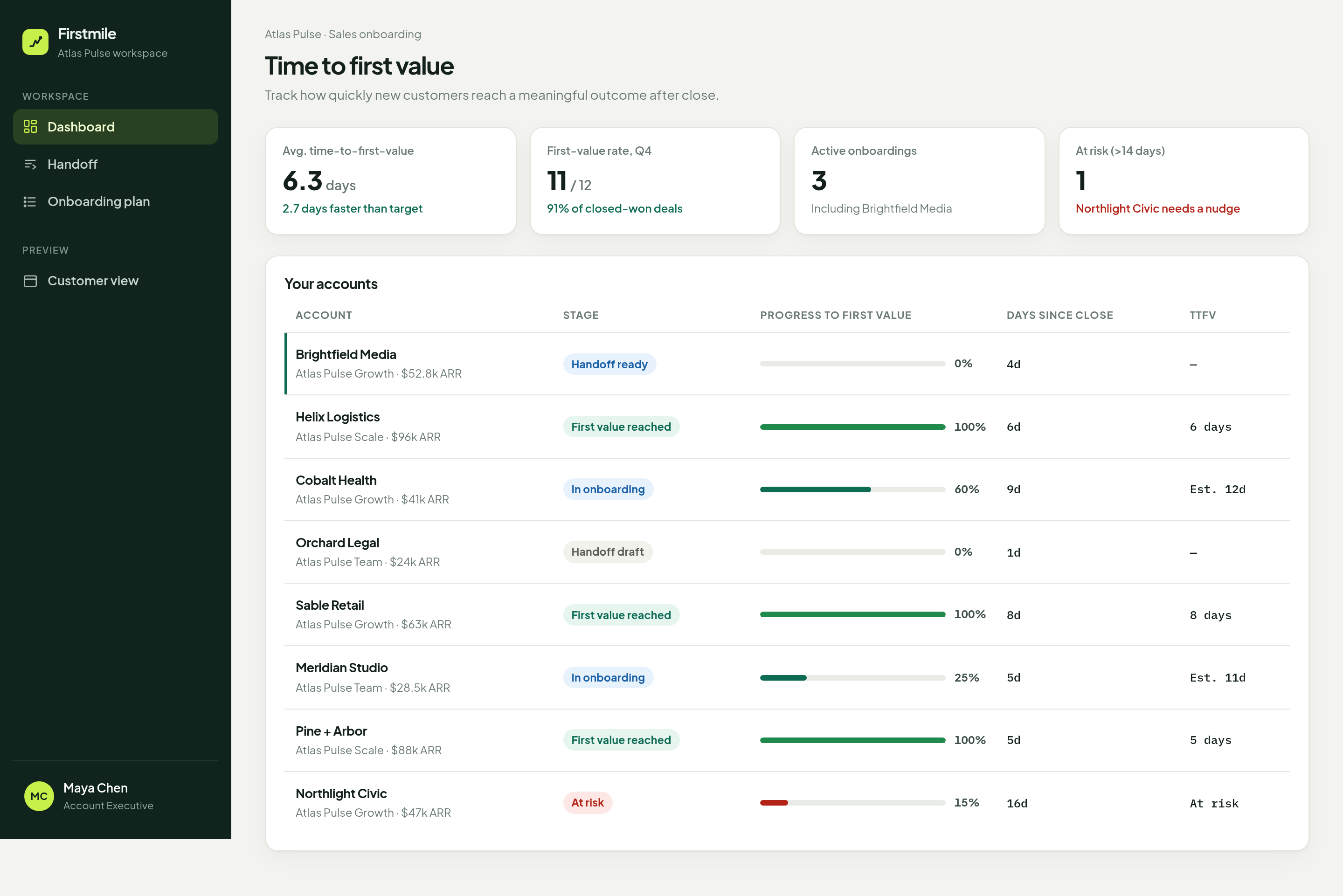
Screens from the working onboarding prototype, using a fictional vendor (Atlas Pulse) and customer (Brightfield Media). The owner cockpit is in design.
Owner model
You decide which accounts Arlen owns, for example by ARR or plan. Every account always has exactly one owner of record, and you can move it at any time.
Guardrails built in: messages about pricing or contracts, first contact with new people and executive escalations always wait for a person. Arlen never pretends to be a named human.
Integrations
Connect your CRM once with OAuth, map a few deal and renewal fields, and add one script tag to your product. Send product events from your backend or the tools you already use. Arlen writes owner, stage and health back to your CRM, and after a ride-along it can add the session note and follow-up tasks. See Rides alongside your reps for the full list.
Product names are trademarks of their respective owners. Listing them doesn't imply endorsement.
<script src="https://app.askarlen.com/widget.js"
data-plan-token="pl_…"
async></script>
POST /api/events
{ "event": "dashboard_created",
"accountExternalId": "cust_123" }
Pricing
Proposal A small platform fee, then fees only when your customers get results. Pricing isn't final, and design partners help shape it.
The base for every team.
Charged only when an outcome is reached.
For larger teams with security requirements.
FAQ
Every account has exactly one owner of record from the day the deal closes to the day it renews: either a person on your team or the Arlen agent. No relay between sales, onboarding and CS, and no account without an owner.
Routine work runs on its own: in-app nudges, replanning steps, reminders to people already on the plan, internal tasks and CRM updates. A person approves anything risky, including messages about pricing or contracts, first contact with someone new, executive escalations and changes inside your customer's product. You can make it stricter, pause it for one account, or pause it everywhere.
Most CS platforms give dashboards and AI assistants to a CS team you already employ, and charge per seat or account band. Arlen is the owner itself. It starts at closed-won with the deal context, works inside your product, and is paid when your customers reach outcomes.
A platform fee, plus fees when outcomes happen: an account reaching first value on time, a Arlen-owned account renewing, or an expansion from a Arlen-sourced play. We agree the definitions with you up front, every outcome links to the evidence, and you review a monthly statement before anything is invoiced. Amounts are still being set with design partners.
First value is the earliest outcome and the easiest to measure, and a customer who never reaches it rarely renews. Arlen starts there, with a plan built from what the customer told sales, then carries the same account through adoption and renewal.
Connect HubSpot with OAuth, add one script tag for the in-app panel, and send product events from your backend so Arlen can see progress. You can launch with manual step completion and add events later.
The roadmap includes SSO, role-based access, encrypted integration tokens, signed widget sessions, a full log of every agent action, audit logs and configurable data retention. Arlen is pre-launch and holds no compliance certifications yet. Design partners get full visibility into the security plan.
A short kickoff, connecting a HubSpot sandbox or a few real deals, sharing baseline numbers (time to first value and retention) so results can be compared, and regular feedback calls during the pilot. In return: early access, direct input on the roadmap, and founding-partner terms.
Design partner program
We're looking for a small group of B2B SaaS teams on HubSpot with more accounts than owners, and a long tail that deserves better. Tell us a little about yours.